Abstract
The paper's question, interface, learning structure, and evidence in one place.
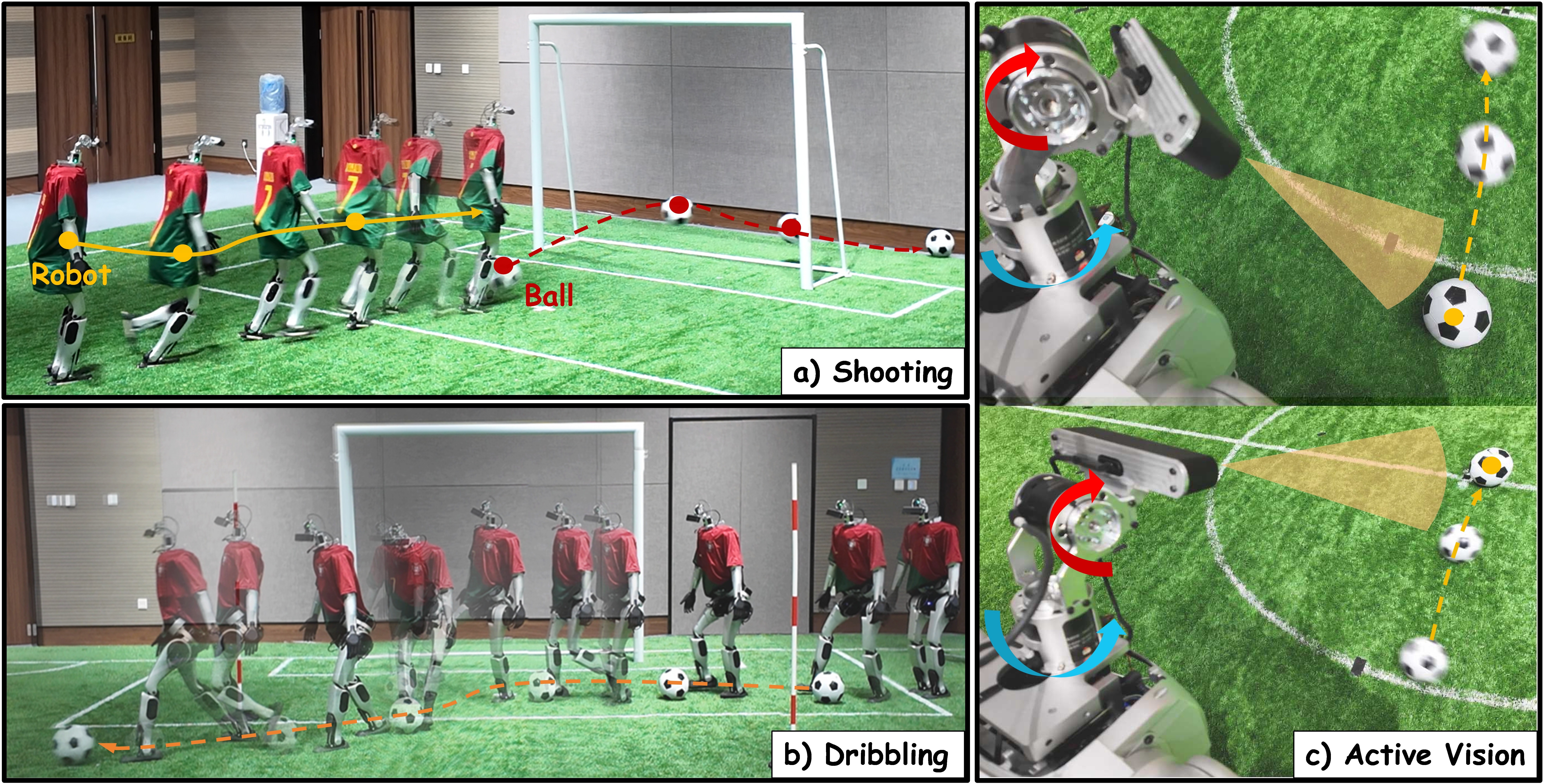
Humanoid soccer contact skills require more than producing high-impact foot–ball contacts: the robot must close the loop over perception, approach, alignment, impact, and recovery while its own motion induces substantial viewpoint changes, frequent loss of the ball from view, and uncertain contact outcomes. In this work, we ask a compact yet stricter question: can a humanoid learn soccer contact skills using only a head-mounted depth image, proprioceptive history, and an optional low-dimensional task command, and directly output 25-DoF joint PD targets without extra runtime perception or planning modules? To this end, we propose DAVIS, a depth-only end-to-end framework for humanoid soccer skills that learns visibility-aware auxiliary geometry during training, and combines GT-to-prediction annealing, task curricula, and AMP-style motion priors to smoothly bridge privileged supervision and real deployment. Built on this framework, we instantiate representative soccer contact skills, including goal-directed shooting and directional dribbling, through task-specific definitions of objects, commands, rewards, and curricula, and validate them through simulation, Noetix E1 real-robot experiments, and ablations.
Overview
Why soccer contact needs active vision, and what DAVIS removes from the runtime stack.
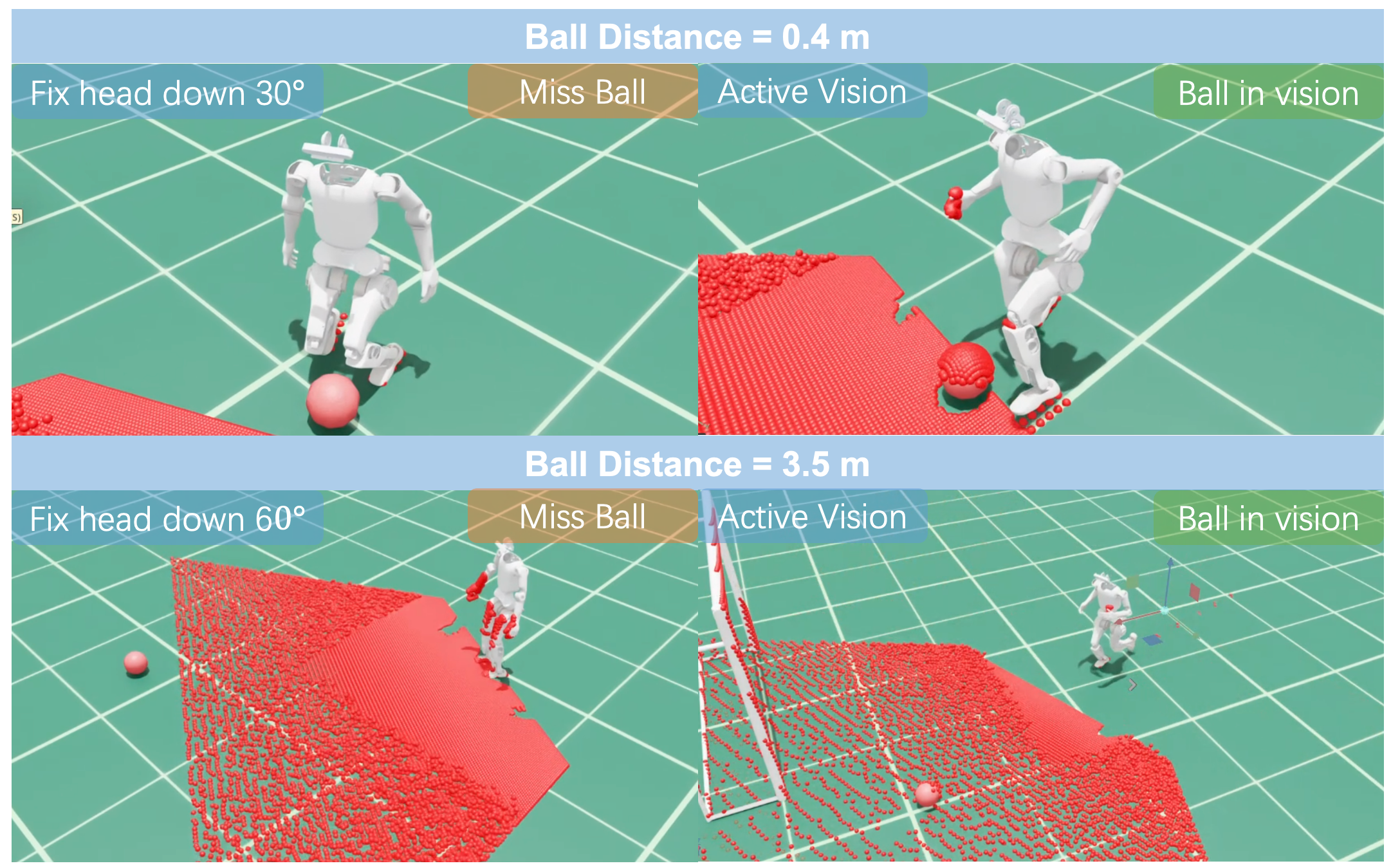
A humanoid soccer policy has to perceive a moving ball, approach it, align the body and foot, make contact, and recover into the next behavior. The camera is mounted on the actuated head, so locomotion and contact continuously change the next observation. A fixed gaze can therefore lose the ball or goal exactly when precise contact is needed. DAVIS treats head motion as part of the control problem rather than as a detached look-at-ball module.
The deployment question is deliberately strict: can the robot infer local task geometry from its own depth image and proprioception, then output whole-body targets without an external detector, localization system, state estimator, or soccer planner? DAVIS puts structure in the training signal while keeping the exported runtime graph small.
One deployable graph
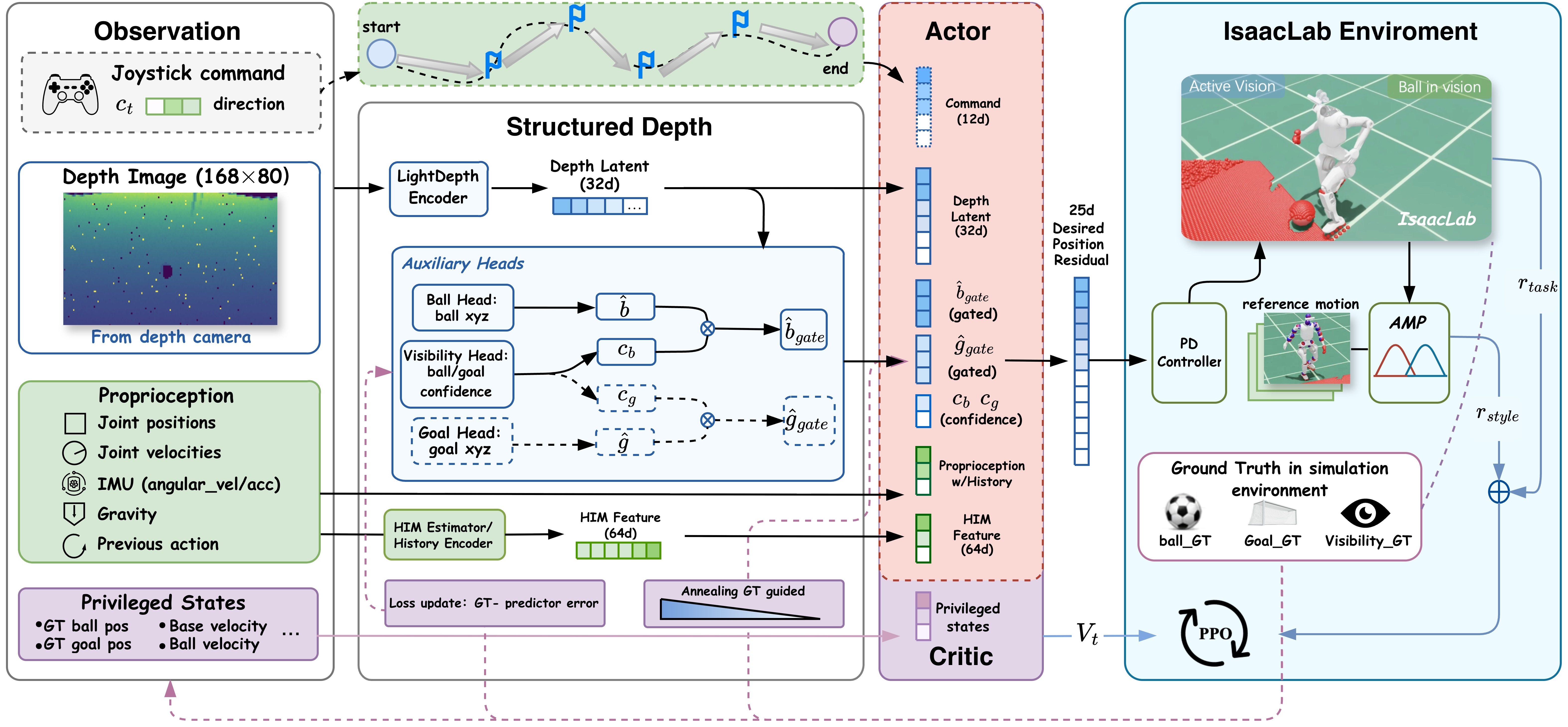
One aligned depth frame, a five-step proprioceptive history, and an optional low-dimensional command are mapped to a 25-dimensional joint residual. No scene state is injected at runtime.
The head is part of the loop
The E1 has 23 body DoFs and 2 head DoFs. Those head actions change the next depth frame, so keeping task objects visible is learned jointly with approach and contact.
Geometry with confidence
Privileged simulation labels supervise geometry and visibility heads, while curricula, GT-to-prediction annealing, and AMP-style priors make the final depth-only policy usable.
Video
Method
Inputs, outputs, auxiliary geometry, and the training-to-deployment transition.
DAVIS models soccer as a partially observed control problem. During training, the critic and auxiliary losses may use simulator state; the actor-side task geometry must eventually come from the same depth/proprioception interface available on the robot.
qdes = q0 + s ⊙ a by the low-level PD controller. The 25 DoFs comprise 23 body joints and 2 active head joints.What the actor sees
Depth is clipped to 0.3–5.0 m, normalized as 2D/5.0 − 1, and zero-filled at invalid pixels. Temporal context comes from proprioceptive history rather than stacked depth frames. Shooting uses 81-D proprioception; dribbling uses 84-D.
Depth plus body history
LightDepthEncoder produces a 32-D depth latent. A HIM feature encodes proprioceptive history and is concatenated with proprioception, command, and confidence-gated object features before the actor MLP.
Privileged critic, deployable actor
Base velocity, contacts, terrain scan, object state, visibility labels, and curriculum variables help value learning and supervision in simulation; they are not runtime actor inputs.
Visibility-aware auxiliary geometry
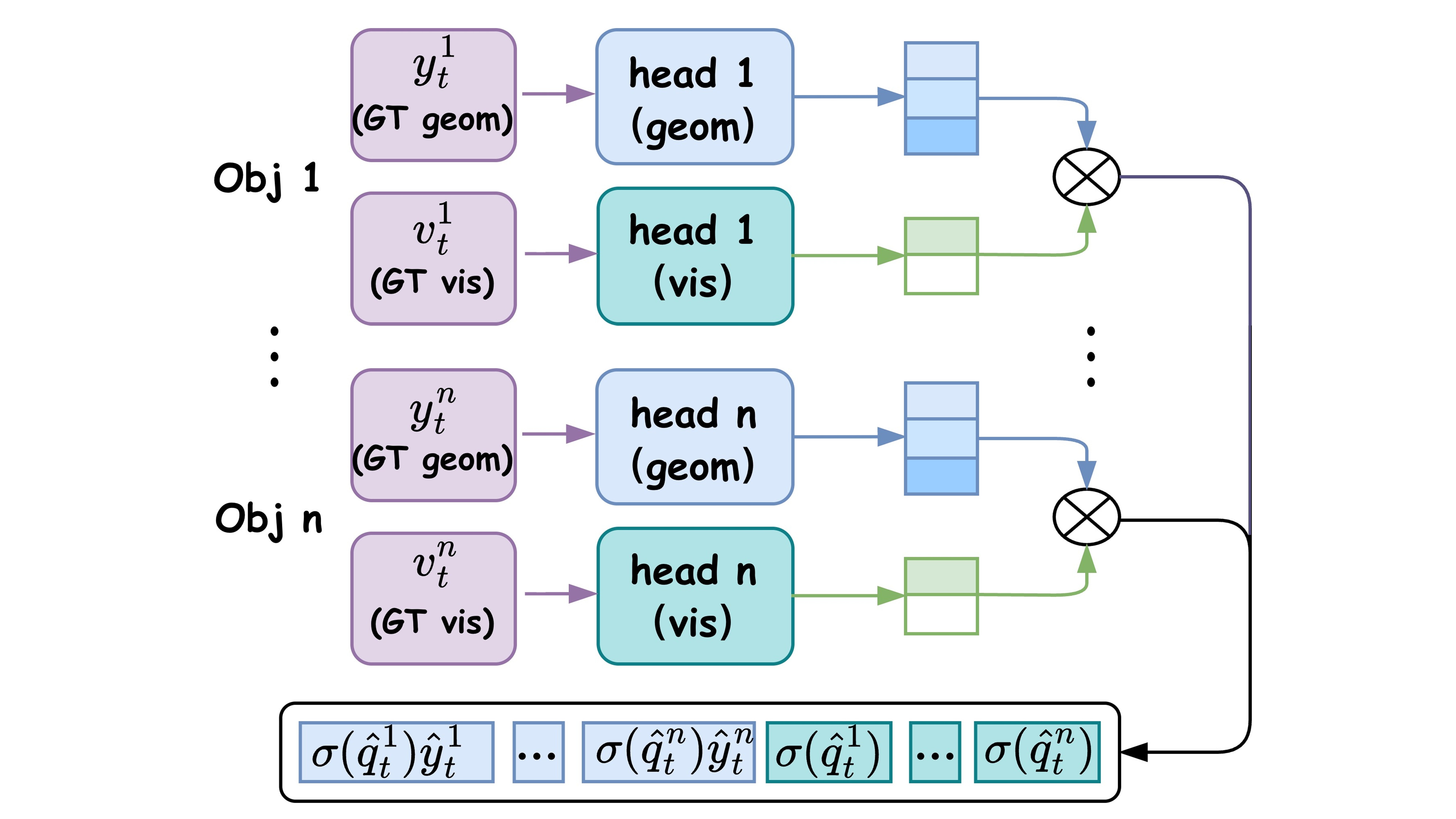
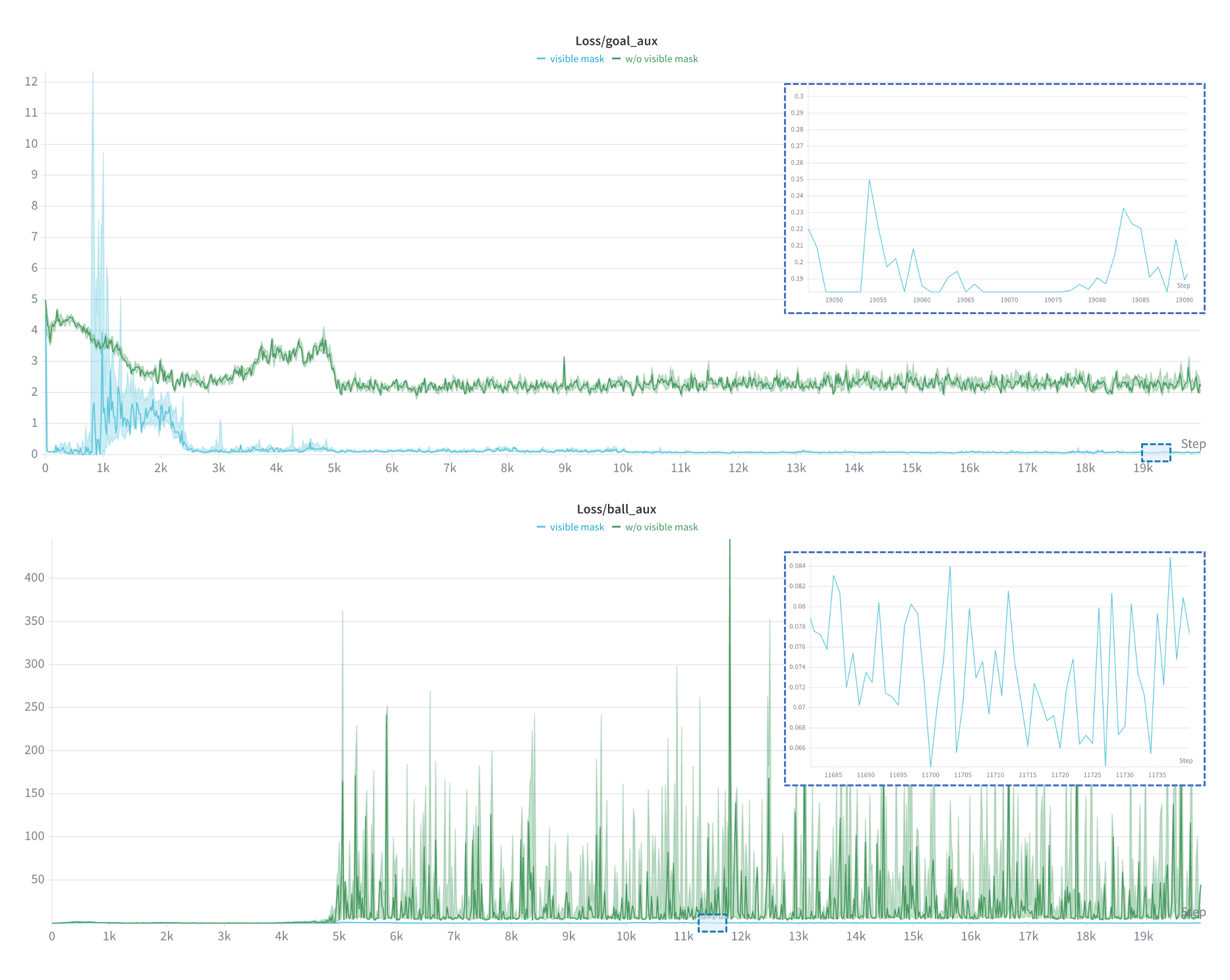
For each task object, an auxiliary head predicts a 3-D center and a visibility logit from the current depth latent. Coordinates are in the right-handed head-yaw-aligned frame: x forward, y left, z up. Geometry loss is applied only when the object is visible; visibility is trained with binary cross-entropy. The predicted center is multiplied by a detached confidence gate clipped to [0.05, 1], so uncertain geometry contributes less to the actor without allowing policy gradients to manipulate the gate.
Task definitions
One observation-to-control interface; different objects, commands, rewards, and curricula.
A skill is specified through task objects, an optional command, task geometry, rewards, and a curriculum. Shooting and dribbling are trained as separate checkpoints, not a single multi-skill policy; they retain the same depth-to-control interface.
Goal-directed shooting
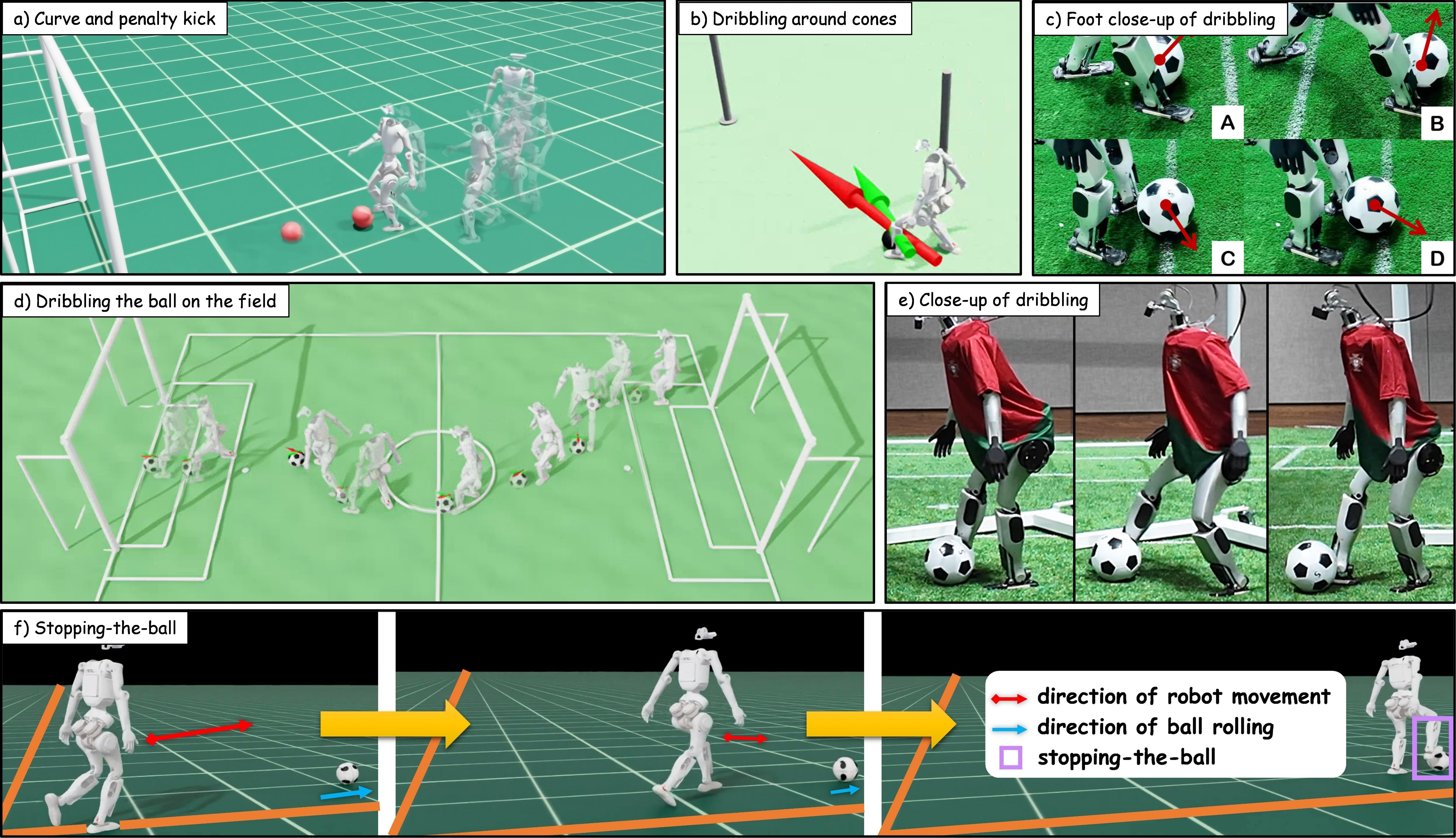
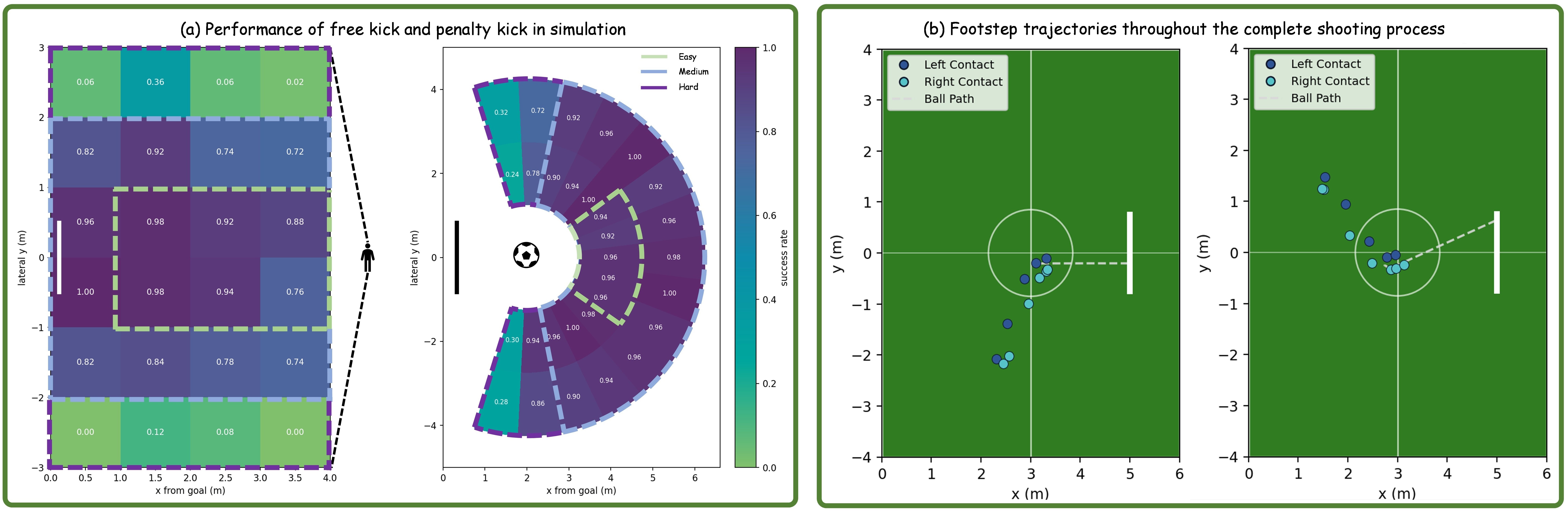
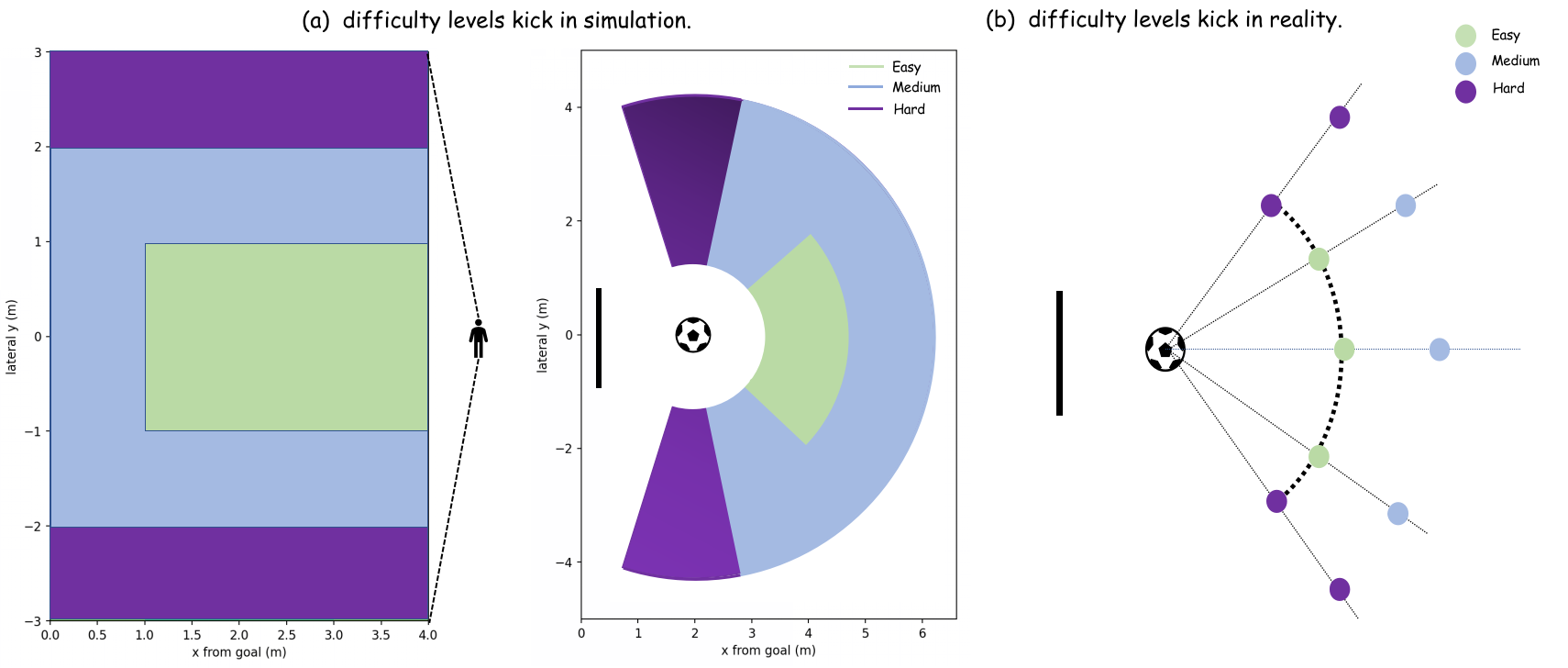
The ball-to-goal direction defines a behind-ball approach target. The policy receives no operator command and learns run-up, head tracking, body alignment, impact, goal-directed exit motion, and post-contact stabilization. Simulation covers penalty kicks (robot 2–3.5 m behind the ball, −100° to +100°) and free kicks (robot 5 m in front of goal; ball x ∈ [0,4] m, y ∈ [−3,3] m).
Directional dribbling
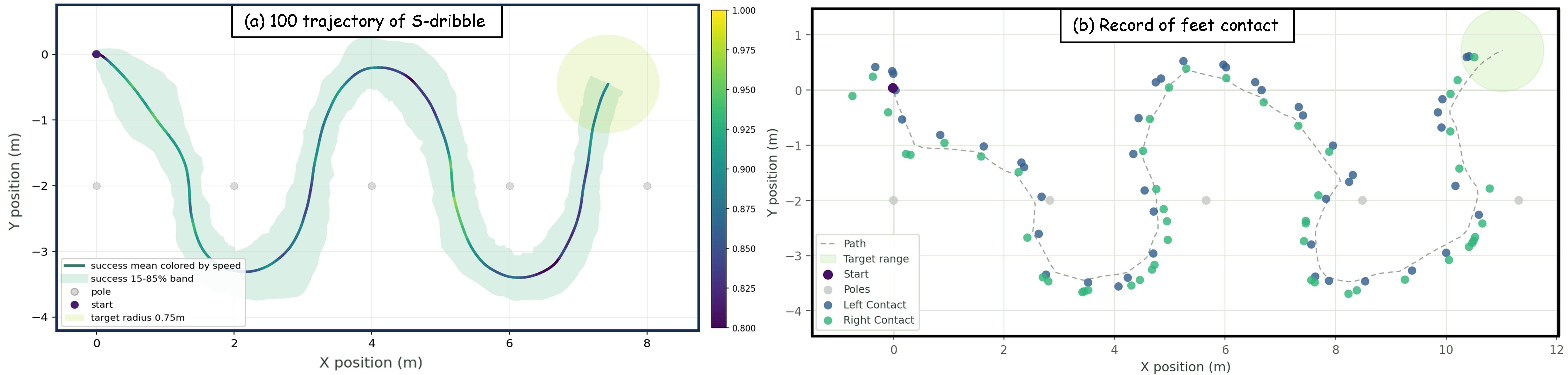
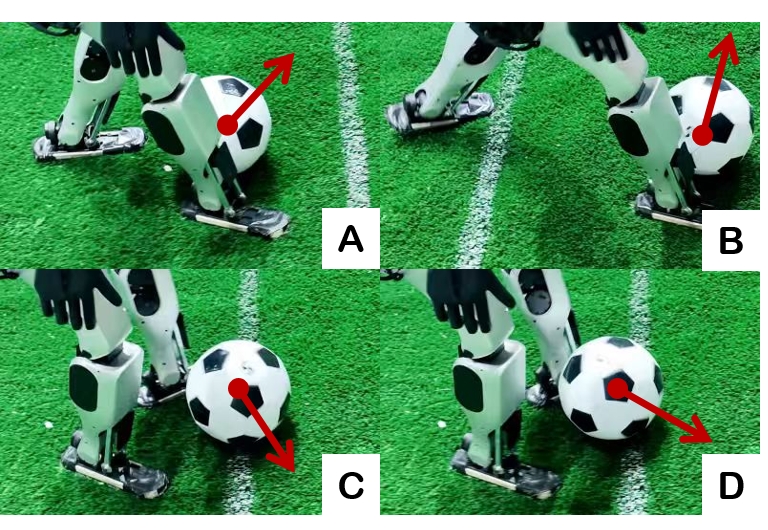
A joystick supplies only a 12-way direction command c = kπ/6. The policy keeps the ball in a controllable band (robot–ball target 0.42 m, ball speed 0.20–1.50 m/s, command-aligned velocity) while making progress. Repeated-S slalom, target reaching, and obstacle traversal test sustained regulation rather than one high-speed strike.
Results
Simulation coverage, real-robot transfer, and controlled evidence for the training structures.
Separate shooting and dribbling policies share the same depth-to-control interface. The evaluation asks whether depth-only contact works, which training structures are necessary, and whether the learned policies transfer to the Noetix E1.
Goal-directed shooting
| Task | Easy | Medium | Hard | Total |
|---|---|---|---|---|
| Penalty kick SR | 0.95 | 0.96 | 0.56 | 0.85 |
| Free-kick SR | 1.00 | 0.88 | 0.71 | 0.85 |
| Real penalty-kick SR | 0.68 (26/38) | 0.57 (28/49) | 0.55 (33/60) | — |
Directional dribbling
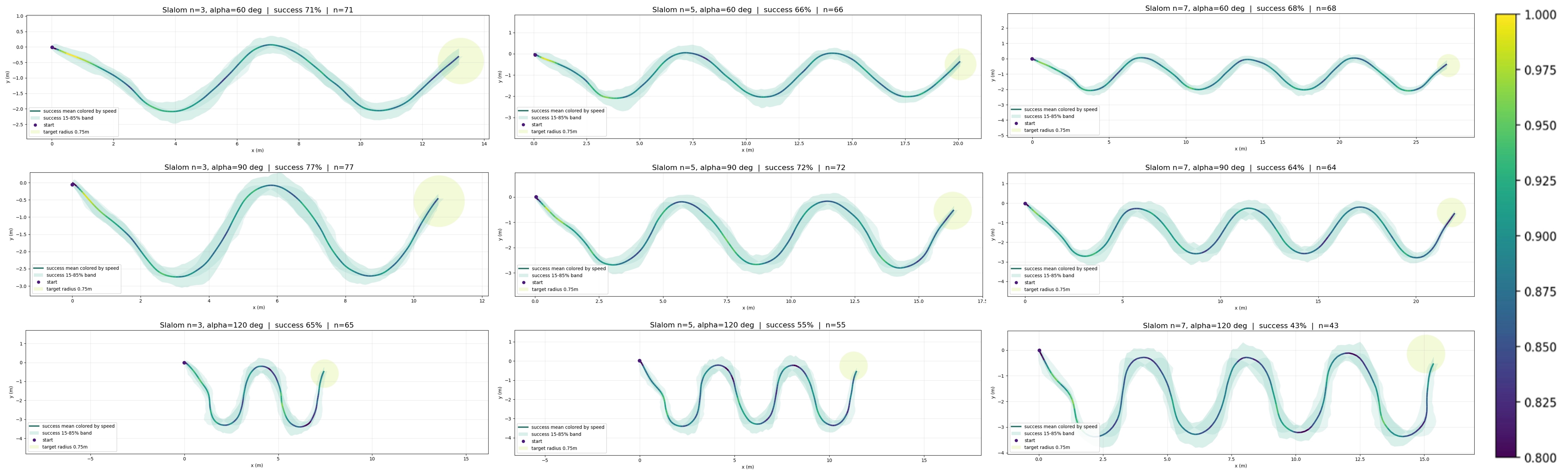
The repeated-S benchmark crosses three pole counts with three turn angles. Each cell is evaluated with 100 trials (900 in total); the overall mean SR is 0.65.
| Metric | N = 3 | N = 5 | N = 7 | ||||||
|---|---|---|---|---|---|---|---|---|---|
| 60° | 90° | 120° | 60° | 90° | 120° | 60° | 90° | 120° | |
| SR ↑ | 0.71 | 0.77 | 0.65 | 0.66 | 0.72 | 0.55 | 0.68 | 0.64 | 0.43 |
| Evel ↓ | 0.69 | 0.74 | 0.91 | 0.74 | 0.73 | 0.80 | 0.71 | 0.81 | 0.97 |
| Rbib ↑ | 0.73 | 0.74 | 0.64 | 0.76 | 0.75 | 0.70 | 0.76 | 0.72 | 0.60 |
Real-robot dribbling records 0.79 (22/28) for target reaching, 0.68 (19/28) for obstacle traversal, and 0.61 (17/28) for slalom. Success requires the robot to remain upright and both robot and ball to finish within 1 m of the target.
Simulation ablations
All variants use the same training parameters and evaluation settings. Shooting columns report SR, angular error in degrees, and valid-contact ratio in percent; slalom columns report SR, velocity error, and ball-in-band ratio.
| Method | Penalty kick | Free kick | Repeated-S slalom | ||||||
|---|---|---|---|---|---|---|---|---|---|
| SR ↑ | Eang ↓ | rcontact ↑ | SR ↑ | Eang ↓ | rcontact ↑ | SR ↑ | Evel ↓ | Rbib ↑ | |
| DAVIS | 0.84 | 23.29 | 99.75 | 0.80 | 30.18 | 99.27 | 0.70 | 0.79 | 0.74 |
| w/o curriculum | 0.62 | 27.40 | 32.53 | 0.55 | 34.42 | 87.67 | 0.51 | 0.77 | 0.69 |
| Auxiliary head w/o anneal | 0.32 | 54.79 | 84.87 | 0.22 | 76.20 | 87.92 | 0.31 | 0.83 | 0.66 |
| Auxiliary head w/o geometry | 0.20 | 53.53 | 87.33 | 0.15 | 69.47 | 78.13 | 0.34 | 0.91 | 0.54 |
| Auxiliary head w/o supervision | 0.13 | 81.87 | 93.33 | 0.14 | 93.66 | 91.67 | 0.30 | 0.95 | 0.48 |
| Auxiliary head w/o visibility gate | 0.34 | 51.97 | 91.33 | 0.29 | 68.44 | 92.08 | 0.27 | 1.06 | 0.64 |
| w/o auxiliary head | 0 | — | 0 | 0 | — | 0 | 0 | 1.45 | 0.05 |
| w/o active vision | 0 | — | 0 | 0.36 | 97.81 | 1.71 | 0 | 1.25 | 0.03 |
| Heuristic head controller | 0.88 | 26.66 | 93.67 | 0.76 | 37.96 | 88.13 | 0 | 0.99 | 0.13 |
The 0.70 slalom SR in the ablation table comes from its controlled ablation set; the 0.65 mean above is from the separate 900-trial benchmark. Removing the auxiliary head drives all three tested success rates to zero; fixing the head drives penalty and slalom success to zero and reduces free-kick success to 0.36. Removing curriculum consistently reduces success, while a heuristic look-at-ball head remains competitive on static penalty kicks but fails on dynamic dribbling.
External protocol
Under the reproduced Dribble Master protocol, DAVIS records 0.88 target-reaching success at 3 m and 0.96 single-obstacle success at 5 m under the 1 m tolerance, using 50 simulation rounds per condition.
Deployment
How the training interface is aligned with the real Noetix E1 control stack.
The simulator renders calibrated ZED2i distance-to-image-plane depth at 168×94, then crops it to 168×80. Matched cropping, sensor-noise perturbations, random masks, camera-pose and dynamics randomization, and identical normalization reduce the sim-to-real gap before ONNX export.

What the robot trials show
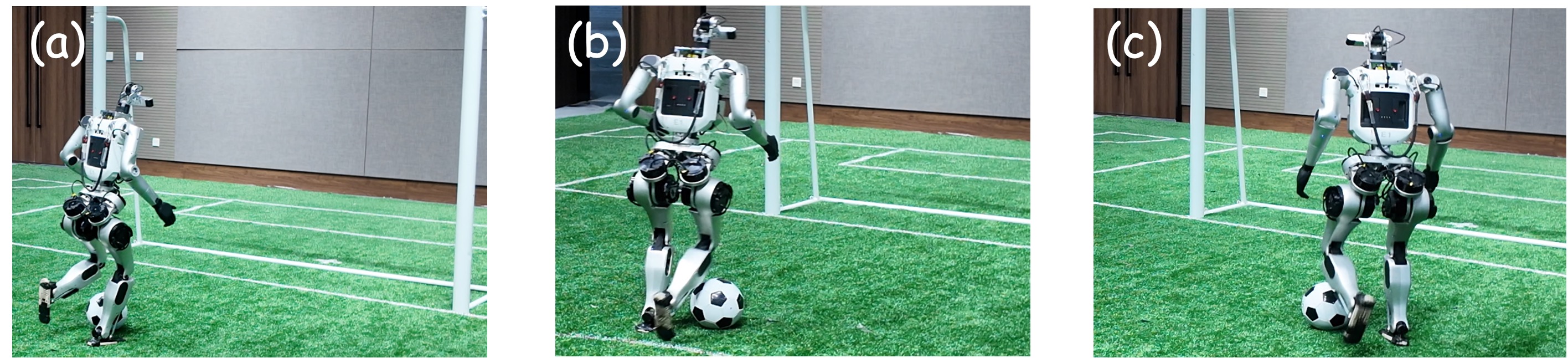
All real-world experiments run on grass with the onboard ZED2i mounted to the 2-DoF head. Shooting evaluates 12 predefined positions, with 26/38, 28/49, and 33/60 successful one-kick goal crossings in Easy, Medium, and Hard settings. Dribbling evaluates target reaching, obstacle traversal, and slalom with one joystick operator; safety uses a tether or staff member plus emergency-stop and projected-gravity fall triggers. If the ball is lost without the learned recovery behavior, the contact policy exits to the default walk–run policy.
Technical supplement
Experimental protocols, policy settings, reward definitions, and deployment details corresponding to the paper appendix.
Robot system and deployment interface
The training and deployment graph keeps the same 25-dimensional action interface.
Depth is clipped to 0.3–5.0 m, normalized as 2D/5.0−1, and zero-filled at invalid pixels. Deployment uses the onboard ZED2i and needs no external localization, object detector, state estimator, or runtime soccer planner.
Evaluation protocols and metrics
The same checkpoints, preprocessing, reset distribution, and thresholds are retained across each controlled comparison.
Metric definitions
| Metric | Definition |
|---|---|
| SR | Shooting: the ball crosses the goal line in one kick. Dribbling: the robot stays upright and both robot and ball end within 1 m of the target; simulation also requires ordered waypoint visits. |
| rcontact | Fraction of shooting trials with valid foot–ball contact followed by goal-directed ball exit. |
| Eang | Angular error between body heading and the robot-to-goal direction. |
| Evel | Mean commanded-versus-actual ball-velocity error after engagement. |
| Rbib | Fraction of engaged dribbling time with the ball inside the controllable band. |
| Bturn | Absolute achieved-versus-commanded mean-turn difference divided by command magnitude. |
| RRτ | Fraction of reaching rounds whose minimum ball–goal distance is below τ. |
Shooting protocol
For free kicks, the robot starts 5 m in front of the goal while the ball spans x∈[0,4] m and y∈[−3,+3] m. For penalty kicks, the ball is 1.5 m in front of goal center and the robot starts 2–3.5 m behind it at −100° to +100°. Trial counts are balanced across spatial strata.
Repeated-S slalom fixture
| Field | Value / definition |
|---|---|
| Task grid | N∈{3,5,7} turns × α∈{60°,90°,120°}; 9 tasks and 900 trials |
| Waypoints | N+2 turning points + N+1 midline gates = 2N+3 total; arm length L=4.0 m |
| Commands | Waypoint attraction plus pole repulsion, snapped to 12 directions; katt=1.0, krep=0.6, d0=1.2 m |
| Engagement | Ball spawns 0.6 m ahead; first contact; 0.15 m/s speed threshold; 5 s timeout |
| Progress | 0.75 m waypoint radius; 5 s segment timer refreshed at each waypoint |
| Control band | Robot–ball distance 0.42±0.10 m; ball speed 0.20–1.50 m/s; velocity not opposite the command |
| Failure | Fall, timeout, out-of-band dwell over 3.5 s, or robot–ball distance over 0.80 m |
Dribble Master protocol
| Field | Dribble Master | DAVIS reproduction |
|---|---|---|
| Robot / input | Booster T1; detector ball position + in-view flag | Noetix E1; depth image |
| Command | Human-issued global ball-velocity vector | Scripted direction only; potential field for reaching, fixed heading for turning |
| Reaching | Distance unreported; final error <1 m | d∈{3,5,8} m; minimum distance below τ∈{0.5,1.0,1.5} m; end at 0.5 m or timeout |
| Obstacle | Physical, not perceived by policy | Virtual midpoint pole, not perceived by policy |
| Turning | ±45°/90° on entry to a 0.4 m circle | ±30°/45°/60°/90° after 1.1 m forward progress |
| Trials | 5 rollouts per turn in simulation; 15 per real task | 50 simulation rounds per condition; Wilson 95% CI |
Dribble Master reaching and obstacle results
Paper Table VI reports target reaching and single-obstacle trials; Table VII separately reports turning. Time is measured from first ball contact until the ball reaches the 1 m tolerance, as mean ± SD over rounds that reached the 1 m tolerance; parentheses give the number of those rounds.
| Task | d | RR0.5 | RR1.0 | RR1.5 | Time to 1 m |
|---|---|---|---|---|---|
| Target reaching | 3 m | 0.88 [0.76, 0.94] | 0.88 [0.76, 0.94] | 0.90 [0.79, 0.96] | 3.0±0.6 s (44) |
| 5 m | 0.82 [0.69, 0.90] | 0.84 [0.71, 0.92] | 0.84 [0.71, 0.92] | 5.7±0.5 s (42) | |
| 8 m | 0.78 [0.65, 0.87] | 0.80 [0.67, 0.89] | 0.80 [0.67, 0.89] | 9.4±1.1 s (40) | |
| Single obstacle | 3 m | 0.92 [0.81, 0.97] | 0.92 [0.81, 0.97] | 0.92 [0.81, 0.97] | 4.8±1.1 s (46) |
| 5 m | 0.94 [0.84, 0.98] | 0.96 [0.87, 0.99] | 0.96 [0.87, 0.99] | 6.4±1.1 s (48) | |
| 8 m | 0.94 [0.84, 0.98] | 0.94 [0.84, 0.98] | 0.94 [0.84, 0.98] | 9.9±1.1 s (47) | |
| DM reaching (real) | Unreported | — | 0.87 [0.62, 0.96] | — | 22.0 s |
| DM obstacle (real) | Unreported | — | 0.93 [0.70, 0.99] | — | 31.4 s |
DAVIS rows are simulation results with n=50; the two reference rows are Dribble Master real-robot results with n=15 at an unreported distance.
Dribble Master turning results
DAVIS uses 50 simulation rounds per condition, with achieved turns summarized over the scored rounds below. Dribble Master turning values come from MuJoCo with 5 rollouts per condition.
| Command | Scored | DAVIS achieved mean±SD | Bias | Per-round | DM mean | DM bias |
|---|---|---|---|---|---|---|
| 30° L | 40 | +28.6±20.5° | 4.8% | 52.9% | — | — |
| 30° R | 39 | −25.5±15.3° | 15.1% | 41.5% | — | — |
| 45° L | 44 | +39.3±14.9° | 12.6% | 27.6% | +43.58° | 3.16% |
| 45° R | 44 | −44.8±18.2° | 0.5% | 32.1% | −46.44° | 3.20% |
| 60° L | 43 | +60.4±19.5° | 0.6% | 26.3% | — | — |
| 60° R | 41 | −53.7±17.2° | 10.6% | 23.3% | — | — |
| 90° L | 42 | +84.0±25.4° | 6.7% | 18.8% | +88.06° | 2.16% |
| 90° R | 43 | −84.9±22.6° | 5.6% | 19.7% | −87.98° | 2.24% |
| Mean bias | — | — | 7.1% | — | — | 2.7% |
Real-robot shooting targets
| Difficulty | Distance | Target angles |
|---|---|---|
| Easy | 2.5 m | −30°, −5°, +5°, +30° |
| Medium | 3.0 m | −30°, −5°, +5°, +30° |
| Hard | 2.5–3.0 m | −45°, +45° |
All 12 positions face the goal. The ball starts 1.5 m in front of the goal; success requires the ball to cross the goal line completely in one kick. Real dribbling covers 4–5 m reaching at ±30°, obstacle traversal with 60–120° turns, and slalom through 2–4 targets spaced 2–3 m apart.
Observation, optimization, and auxiliary supervision
Privileged labels shape training; the deployed actor receives only onboard observations and predicted auxiliary features.
Observation and network configuration
| Item | Setting |
|---|---|
| Actor sensory input | Single depth frame + five-step proprioceptive history; optional low-dimensional task command |
| Proprioception | 81-D for shooting; 84-D for dribbling |
| Depth encoder / latent | LightDepthEncoder / 32-D |
| HIM hidden-state estimate | 3-D |
| Actor / critic MLP | [512,256,128], ELU; normalization enabled |
| Auxiliary heads | Task-dependent: ball geometry and visibility; plus goal geometry and visibility for shooting |
| Training-only critic signals | Base linear velocity, foot contacts, terrain scan, object geometry, auxiliary labels, and curriculum variables |
PPO and AMP-HIM settings
| Item | Value |
|---|---|
| Rollout / optimization | 24 steps per environment; 5 PPO epochs; 4 mini-batches |
| Learning rate | 1×10⁻³, adaptive |
| γ / λ / PPO clip | 0.99 / 0.95 / 0.2 |
| Entropy / value loss / max gradient norm | 0.01 / 1.0 / 1.0 |
| Discriminator | Wasserstein; [1024,512]; lr 5×10⁻⁶; replay buffer 200,000 |
| AMP reward coefficient / interpolation | 0.8 / 0.8 |
| Auxiliary loss weights | Goal geometry 1.0; ball geometry 1.0; goal visibility 0.2; ball visibility 0.2 |
The 136-D AMP state uses joint positions, key-body positions, base linear and angular velocity, joint velocity, and foot contacts. Head dimensions are masked so imitation does not constrain active visual tracking.
Visibility-aware auxiliary features
For each object i, geometry and visibility heads use the current depth latent. Coordinates are head-yaw aligned: x forward, y left, and z upward. An object is visible when any predefined structural point lies inside the valid camera field of view and depth range; the geometry target remains its center.
Geometry is supervised only when the object is visible. The source leaves ℓgeo generic; visibility uses binary cross-entropy on logits.
Ground-truth to prediction transition
The square-root ramp is monotone and can pause when the auxiliary-loss EMA is too high. The detached gate prevents policy gradients from changing visibility confidence through the actor input. At deployment β=1, so every auxiliary feature comes from depth prediction.
Task rewards
Shooting and dribbling retain the same observation-to-control interface while changing task objectives and reward terms.
Goal-directed shooting
Training uses 1,024 parallel environments, 20 s episodes, and a 0.005 s physics step. A near-ball sigmoid gate modulates alignment and contact rewards.
| Reward term | Weight | Reward term | Weight |
|---|---|---|---|
| Approach ball | 3.0 | Adaptive velocity | 2.0 |
| Head track ball | 3.0 | Keep in horizon | −0.5 |
| Body follow head | 2.0 | Robot behind ball | 1.0 |
| Lateral kick-line penalty | 1.0 | Head yaw align | 1.5 |
| Ankle toward ball | 2.0 | Ball velocity | 4.0 |
| Ball velocity direction | 1.5 | One-shot score | 10.0 |
| AMP motion prior | 0.8 | Safety / style | Task-dependent penalties |
Directional dribbling
The policy follows a 12-way command ring for 60 s episodes. The ball-band half-width tightens from 0.15 to 0.10 m, and the out-of-band dwell limit tightens from 6.0 to 3.5 s.
| Reward term | Weight / setting |
|---|---|
| Ball command | 5.0 |
| Body command | 0.4 |
| Dense re-approach | 2.0 |
| Out-of-band | −1.0 |
| Ball in view | 1.0 |
| Body follow head | 0.6 |
| Fall / bad orientation / lost-control termination | −1.0 |
| Head-masked Wasserstein AMP prior | Coefficient 0.8; interpolation 0.8 |
| Safety / style | Task-dependent posture, sliding, force, limit, acceleration, action-change, and upper-body penalties |
Domain randomization and sim-to-real
Camera alignment and randomized sensing, dynamics, and disturbances are applied before ONNX deployment.
The simulator renders calibrated ZED2i distance-to-image-plane depth at 168×94, then crops it to 168×80. Both simulation and robot use the 0.3–5.0 m range, 2D/5.0−1 normalization, and zero for invalid pixels. Temporal context comes from proprioceptive history rather than stacked depth frames.
| Category | Perturbation | Range / value |
|---|---|---|
| Depth | Valid depth | 0.3–5.0 m |
| Distance-proportional / Gaussian noise | 0.01 / 0.005 | |
| Salt-and-pepper / stripe dropout / edge drag | 0.01 / 0.005 / 0.01 probability | |
| Rectangular mask | 0.1 probability; 10–25% size | |
| Ball-region occlusion | 0.2 probability; 2–10 px radius | |
| Partial occlusion | 45–85% | |
| Border near-field noise | 0.15 probability | |
| Camera intrinsics | ±0.3–±0.5 px | |
| Camera pose | Translation | 0.02–0.04 m |
| Rotation | 0.025–0.060 rad | |
| Robot | Joint-position offset | ±0.02 rad |
| Base COM | ±0.05 m | |
| Base mass | ±5 kg | |
| Actuator stiffness / damping | 0.8–1.2 scale | |
| Ball / pushes | Ball mass | 0.36–0.56 kg |
| Push interval | 3–15 s | |
| External linear velocity | x,y∈[−1,1] m/s; z∈[−0.2,0.2] m/s | |
| External angular velocity | [−0.78,0.78] rad/s |
Additional skills
The same depth-only actor interface is retrained with task-specific objects, rewards, resets, and schedules.
Powerful shot
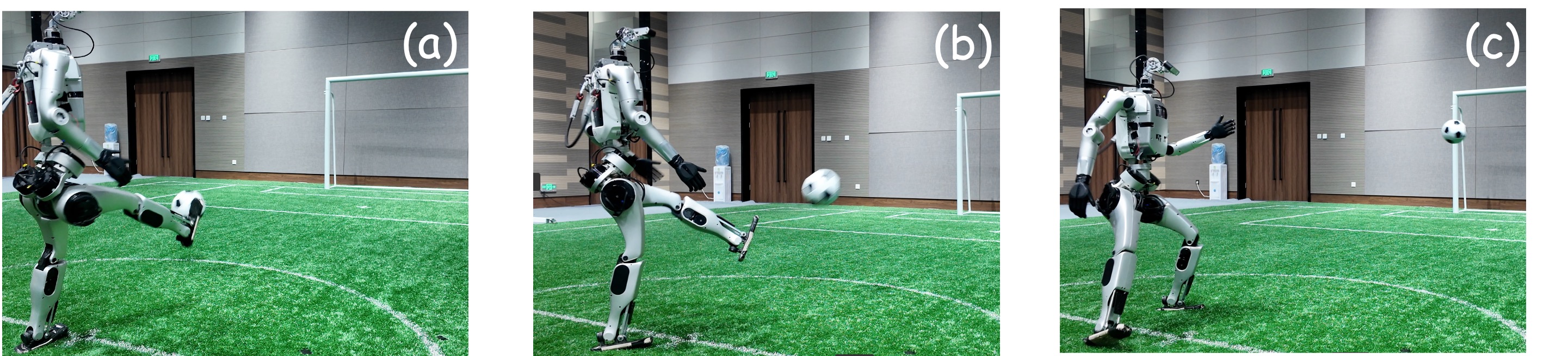
A near-ball gate first weights foot-speed effort by distance, then introduces horizontal ball-speed and displacement rewards. The scales enter sequentially; the AMP kick prior starts once enough environments reach the near-ball zone. Deployment still uses the depth actor without a separate locator or shooting controller.
Obstacle-aware dribbling
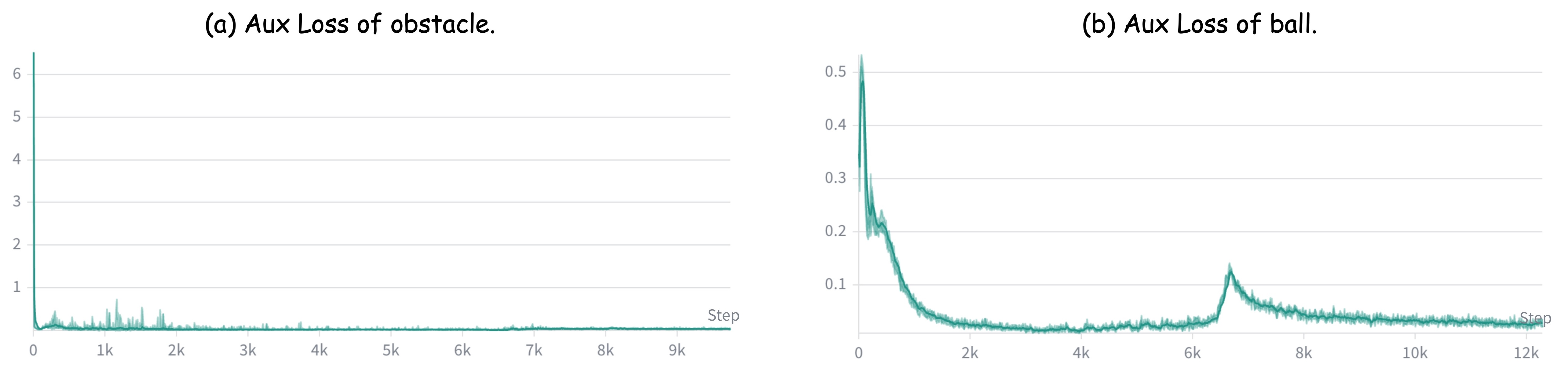
The existing per-object mechanism is extended with an indexed obstacle geometry/visibility head on the shared depth latent. During training, direction-aware rewards track a command deflected tangentially around the nearest in-path obstacle. Outside its influence radius, the reward target returns to the requested direction:
Here ut is the ball-to-obstacle bearing, tt is the command-normal unit vector toward the obstacle-clearing side, wt ∈ [0,1] is a proximity weight that vanishes beyond the influence radius, and κ is the steering gain. Every direction-aware dribbling reward tracks the deflected command. The result is obstacle avoidance within the same depth-only actor and control loop, without a separate runtime avoidance controller.
Ball-loss recovery
The policy searches and slows down through learned rewards and the visibility timer; no separate search controller is introduced.
BibTeX
@misc{jin2026davisdepthonlyendtoendactivevision,
  title={DAVIS: A Depth-Only End-to-End Active-Vision Framework for Humanoid Soccer Skills},
  author={Jiakang Jin and Yixiao Huo and Pengyuan Wang and Yinan Han and
          Tingxuan Zhang and Zhuobing Zhao and Xuanxin Zhou and Zhangchen Ye and
          Enxuan Ruan and Yifei Bao and Jiankun Yang and Chenghao Sun and
          Wenhao Cui and Xiaoyu Tian and Yiming Li},
  year={2026},
  eprint={2609.28175},
  archivePrefix={arXiv},
  primaryClass={cs.RO},
  url={https://arxiv.org/abs/2609.28175}
}